
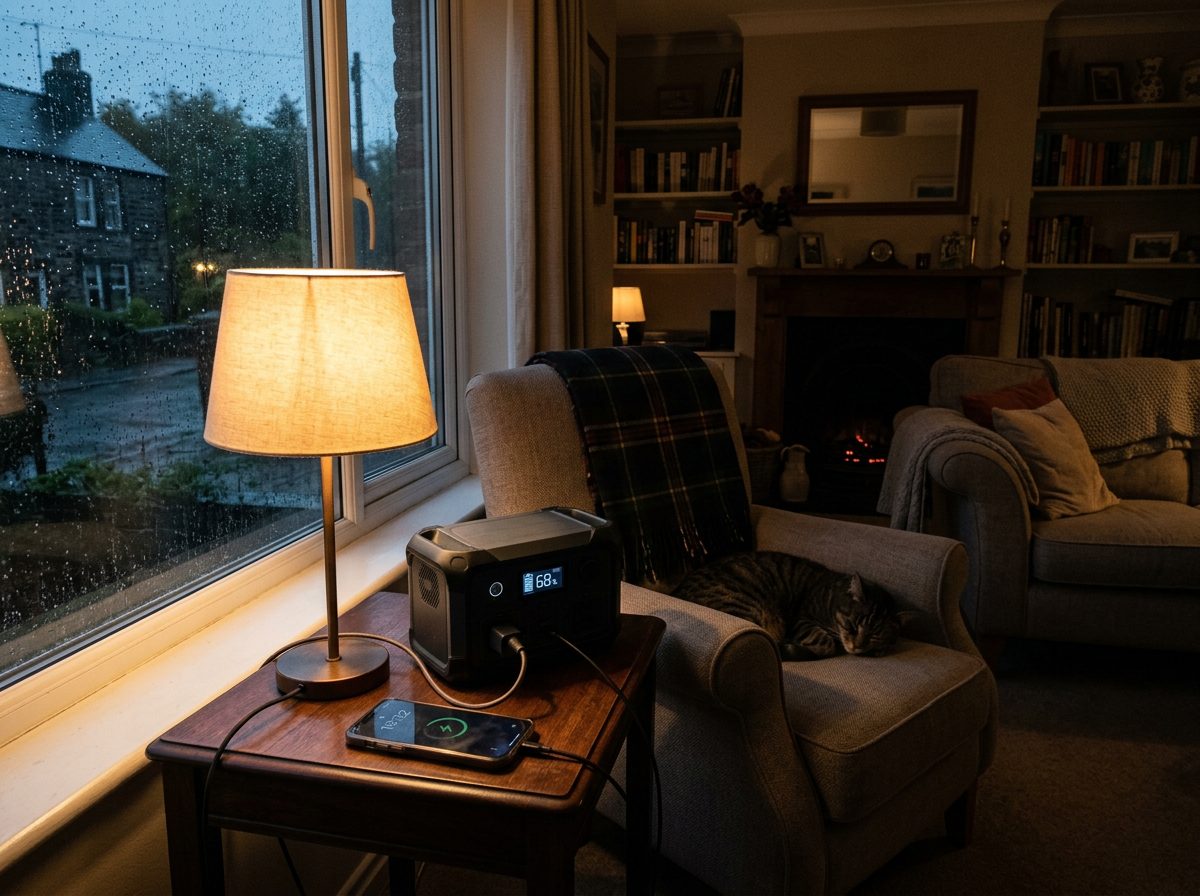
How to choose the best portable power station
A portable power station (sometimes sold as a "solar generator" or "battery generator") is a rechargeable battery pack with a built-in inverter, UK sockets, USB ports and a 12V outlet. It runs silently with no fumes, so you can use it indoors, in a tent or in a van. Pick one by how much energy you need (Wh), the most power you'll draw at once (W), and how you'll recharge it.
What size: 300Wh, 1000Wh or 2000Wh+
| Use | Usual capacity |
|---|---|
| Phones, lights, camera, drone for a weekend | 200Wh to 500Wh |
| Camping with a 12V cool box, laptop work | 500Wh to 1000Wh |
| Campervan, CPAP for several nights, power tools | 1000Wh to 2000Wh |
| Power cuts: fridge freezer, router, lights | 2000Wh and up |
To size one properly, multiply each device's watts by the hours you'll run it, add them up, then add about 20% because the inverter loses some energy turning battery power into mains. The size calculator does this for you. A bigger battery is heavier: around 10kg for 1000Wh and 20kg to 30kg for 2000Wh to 3000Wh, so think about how far you'll carry it.
Output (W) and surge
The continuous output in watts decides which appliances will work. Phones, laptops, lights and cool boxes need very little. A microwave, hair dryer or toaster needs 800W to 1500W, and a UK kettle needs 2200W to 3000W, which means a 2000W or 3000W model. The surge figure is a short peak for motors starting up (fridges, pumps, power tools), not what it can run all day. Some brands have a mode that runs heating appliances at a reduced power: your kettle will work, just slowly.
LiFePO4 or lithium-ion
Most new power stations use LiFePO4 (lithium iron phosphate) cells. They are a little heavier but are rated for 3,000 to 4,000 charge cycles before dropping to 80% capacity, and they are more stable if damaged. Older and cheaper lithium-ion (NMC) models are lighter but are typically rated for 500 to 800 cycles. If you'll use it every week, LiFePO4 is worth it.
Charging: mains, car and solar
Fast mains charging is the big improvement of the last few years: many 1000Wh models now go from empty to full in about an hour. Car charging through the 12V socket is slow (around 100W), so a full charge takes most of a day's driving. For solar, check the maximum solar input in watts and the voltage range, and match your portable solar panels to it. A solar generator bundle includes a matched panel. Use the solar calculator to see what to expect in a UK summer or winter.
UPS and home backup
A power station with UPS (or EPS) mode sits between the wall socket and your devices and switches over to battery within a few milliseconds if the power goes, so a computer, router or CPAP machine keeps running. That makes it a simple backup for power cuts, without any wiring. Bigger systems can connect to a home circuit, but that must be done by a qualified electrician with the right changeover switch. Never plug a power station into a wall socket to "back-feed" your house.
EcoFlow, Jackery, Bluetti, Anker and the rest
EcoFlow (River and Delta ranges) is known for very fast charging and a good app. Jackery (Explorer range) is simple, well built and popular with campers. Bluetti (Elite, AC and EB ranges) offers a lot of capacity for the money and expandable batteries. Anker SOLIX and DJI Power are newer to the market with strong, compact models, while ALLPOWERS and VTOMAN are good-value alternatives. All the big names now use LiFePO4 in their newer models.
Frequently asked questions
What size power station do I need?
300Wh to 500Wh for phones, lights and a laptop over a weekend; around 1000Wh for a cool box and laptop for two or three days; 2000Wh or more to keep a fridge freezer and router going through a power cut. The calculator gives a figure for your devices.
Can I use a power station indoors?
Yes. There's no engine and no fumes, so it's safe indoors, unlike a petrol generator. Keep the vents clear and follow the maker's temperature range.
Can a power station run a fridge?
Yes. A fridge freezer uses about 1kWh to 1.5kWh a day but has a start-up surge, so choose a model with at least 1000W continuous output. A 2000Wh unit will usually keep one going for a day or more.
How long does a power station hold its charge?
Most lose only a few percent a month in storage. Top it up every three months and store it at 60% to 80% for the longest battery life.
Is a power station worth it for power cuts?
For short cuts, yes: one with UPS mode keeps your router, lights and fridge going with no setup. For long cuts, pair it with solar panels or look at a larger home backup model.